



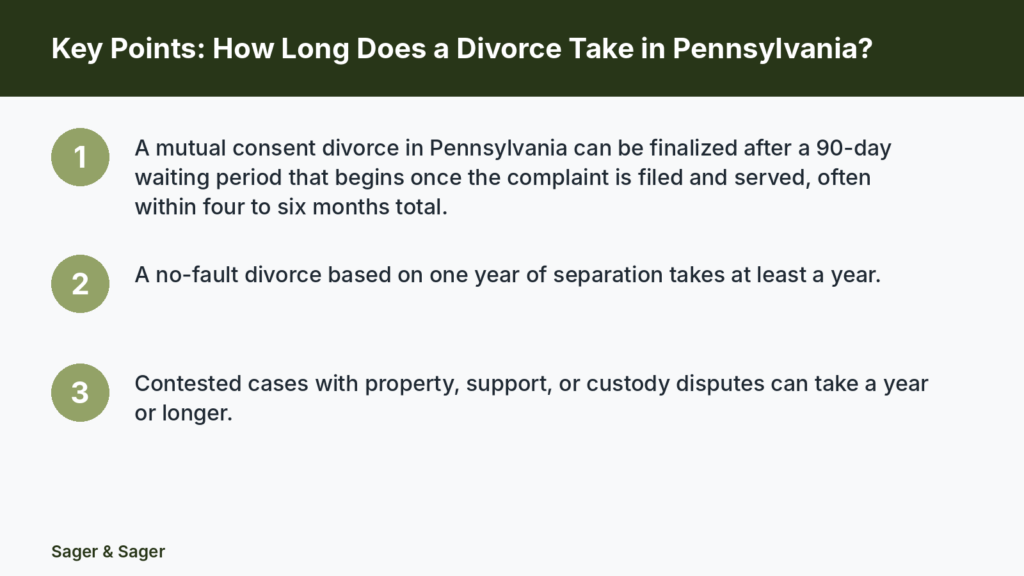
A mutual consent divorce in Pennsylvania can be finalized after a 90-day waiting period that begins once the complaint is filed and served, often within four to six months total. A no-fault divorce based on one year of separation takes at least a year. Contested cases with property, support, or custody disputes can take a year or longer.
Pennsylvania divorce timelines depend mainly on the grounds for divorce and whether the spouses agree on the issues. Some divorces move quickly once the waiting period ends, while others take much longer because of disputes over property, alimony, or children.
This article focuses on timelines by ground. For details on simpler cases, see our earlier discussion of uncontested divorce.
Mutual Consent Divorce
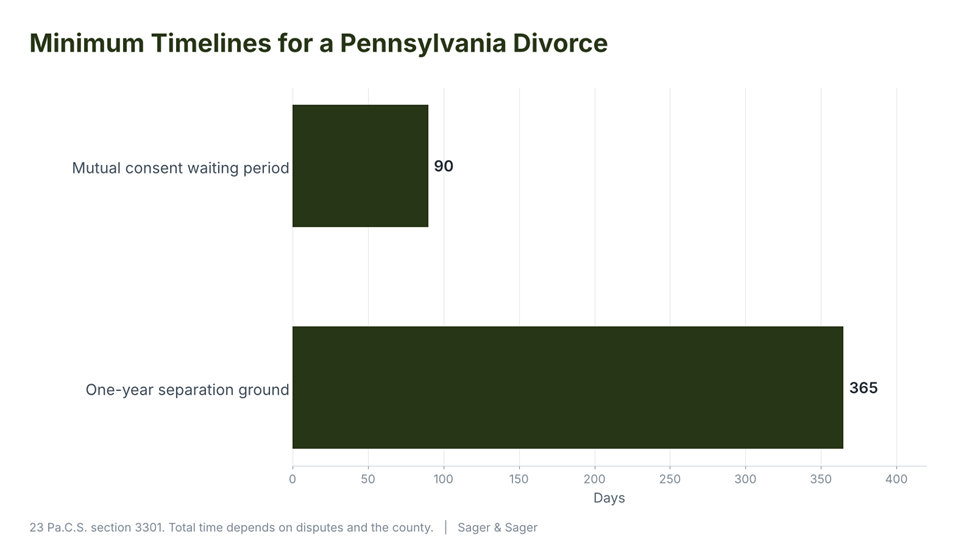
Under 23 Pa.C.S. section 3301(c), spouses can divorce by mutual consent when the marriage is irretrievably broken. After the complaint is filed and served, both spouses must wait at least 90 days before signing affidavits of consent. Once the affidavits and other paperwork are filed, the court can enter the divorce decree. If the spouses have already resolved property and support issues, the entire process often takes four to six months. Learn more about divorce in Pottstown and the surrounding area.
One-Year Separation Divorce
Under section 3301(d), a spouse can seek a no-fault divorce without the other spouse’s consent after the parties have lived separate and apart for at least one year. Pennsylvania shortened this period from two years to one year for separations beginning on or after December 5, 2016. Once the separation requirement is met and the affidavit is filed, the other spouse has a chance to respond. The overall timeline often runs well beyond a year from separation, especially if economic claims remain.
Fault-Based Divorce
Pennsylvania still allows fault grounds, such as adultery, desertion for one year, cruel and barbarous treatment, and bigamy. Fault divorces are less common today because they require proof and often take longer. They may be used in specific strategic situations.
Equitable Distribution Adds Time
If spouses disagree about dividing marital property, the court must resolve equitable distribution before finalizing the divorce in most cases. This may involve:
- Financial disclosures and inventories
- Valuations of homes, businesses, and retirement accounts
- Conferences with a divorce master
- A hearing before the master and possible exceptions to the court
Property disputes are often the main reason a Pennsylvania divorce takes a year or more.
Alimony and Support Claims
Claims for spousal support, alimony pendente lite, and post-divorce alimony may proceed alongside the divorce. Support conferences can happen relatively quickly, but alimony is usually decided with equitable distribution, which can add time.
Bifurcation in Limited Cases
In some situations, a court may grant the divorce before property issues are resolved, which is called bifurcation. Courts approve bifurcation only in limited circumstances and generally require protections for the spouse who might be disadvantaged, such as preserving health insurance or other benefits. Most Pennsylvania divorces resolve economic claims before the decree is entered.
Custody Runs on Its Own Track
Custody cases are separate actions in Pennsylvania and can proceed before, during, or after the divorce. Custody conciliation conferences are often scheduled within a few months of filing in counties such as Berks and Montgomery. Learn more about our Berks County family law services.
Factors That Speed Up or Slow Down a Divorce
- Agreement on property, support, and custody
- Complete and timely financial disclosure
- Complex assets such as businesses or pensions
- County court schedules
- Whether either spouse delays signing documents
Negotiating a marital settlement agreement is usually the fastest path.
Tips for Keeping Your Divorce on Track
- Gather financial records early.
- Respond promptly to requests from your attorney.
- Consider mediation for disputed issues.
- Focus on major issues rather than small items.
- Keep communication with your spouse civil and in writing.
Frequently Asked Questions
How long does a mutual consent divorce take in PA?
At least 90 days after filing and service, often four to six months total.
How long must we be separated for a no-fault divorce in PA?
One year for separations that began on or after December 5, 2016.
Can a PA divorce be finalized if property is not divided?
Usually, property issues are resolved before the decree, unless the parties agree otherwise.
Why do some Pennsylvania divorces take more than a year?
Disputes over property, alimony, or business valuations commonly add time.
Is custody part of the divorce case in PA?
Custody is handled as a separate action and can move on its own timeline.
Can my spouse stop a divorce in Pennsylvania?
A spouse can delay a mutual consent divorce by not consenting, but the one-year separation ground does not require consent.
What are the steps to get a divorce in Pennsylvania?
File and serve a divorce complaint, satisfy the waiting or separation period, resolve property, support, and custody issues by agreement or court order, then file the final paperwork asking the court to enter the decree.
Talk to a Pennsylvania Divorce Lawyer
Sager & Sager helps spouses in Pottstown, Berks County, and the surrounding area move through divorce efficiently and protect what matters. When you call, our team will ask about your separation, assets, and children, then explain which path and timeline fit your situation.